

Artwork by Dane Suarez
To Hell and Back
Music by Jake Heggie
Libretto by Gene Scheer
Eurydice
Music by Jodi Goble
Text from the poem by H.D. (Hilda Doolittle)
L’altra Euridice
Music by Jonathan Dove
Libretto by the composer, after Italo Calvino
Orpheus Retold brings together three radically different one-act treatments of the world’s oldest love story, each one upending the myth’s assumptions about who suffers, who is to blame, and who actually gets to speak. Emily Margevich, Chelsea Laggan, and Gerard Moon bring the trio of works to life in an evening that moves from rage to grief to devotion. Experience the Orpheus legend from three perspectives through the music of three living composers, Jake Heggie, Jodi Goble, and Jonathan Dove, on April 9 and 11, 2027, at The OperaDelaware Studios.
Chamber Chats before each performance: Friday, April 9, at 6:45 PM with Sable Strout, and Sunday, April 11, at 1:15 PM with Dr. Tyson Sukava, at The OperaDelaware Studios. Pre-register for a Chamber Chat ↗


| Stage Director | Sable Strout |
| Music Director | Cris Frisco |
| Lighting Designer | Tláloc López-Watermann |
The collaboration of Jake Heggie and Gene Scheer has produced some of contemporary opera’s most important titles, including Moby-Dick and It’s a Wonderful Life. In To Hell and Back, the team reaches beyond the myth of Orpheus and Eurydice to the abduction of Persephone, daughter of the harvest goddess Demeter, who was stolen by Pluto, god of the underworld. Scheer drew his text from the story as Ovid tells it in the Metamorphoses and shaped it into a modern tale of spousal abuse. The result is a devastating chamber drama for two voices that reframes mythology with unflinching contemporary clarity.
Jodi Goble’s Eurydice is a through-composed setting of H.D.’s Imagist poem, which tells the Orpheus myth from the usually silent perspective of its heroine. H.D. breaks the silence imposed on Eurydice, giving her a furious, unflinching voice to confront the husband whose backward glance doomed her. Goble sets this modernist text to music, turning a poem of grief into a reckoning and finally giving Eurydice the last word. OperaDelaware’s performances are the world premiere of a new version of Eurydice, written specifically for Company Artist Emily Margevich.
L’altra Euridice comes from Tales of Hope and Desire, Jonathan Dove’s trilogy of one-act operas that look at myth and longing through radically reimagined lenses. Following Italo Calvino, Dove turns the Orpheus story inside out: the opera retells the myth from the perspective of Pluto, god of the underworld, reversing the roles of hero and villain that have defined it for thousands of years. In Calvino’s telling, Pluto is not a monster but a devoted partner who has spent his life with Eurydice deep within the earth, dreaming of bringing the planet to life from its core, only to lose her when Orpheus lures her to the surface with his deceptive, seductive song. It is a love story told by the one history has always cast as the villain, and once you hear his side, you may never think of the myth the same way again.
Stephanie has escaped a violent marriage and is rebuilding her life in Arizona. She calls Anne, her former mother-in-law, back in their small Appalachian town, to thank her for a letter she wrote. In the letter Stephanie told her story, and Anne was its hero. Anne brushes her off and hangs up, then starts to read. As the two women relive what happened, the story comes out: Stephanie’s brutal wedding night, Anne’s anguish over her own son, and the Saturdays they spent in the garden, where Anne taught her that tender shoots bruise “but they’re stronger than you know.” When Anne finally finds Stephanie beaten in that garden, she sells her mother’s ring to buy her a ticket to freedom. Rescue comes with a cost, though. The final phone call belongs to Anne, and her last words are to ask Stephanie not to call again.
Orpheus has looked back, and Eurydice is swept back into the underworld — a place of ash, cinders and colorless light. She had grown used to the dark, almost at peace, and he woke her only to lose her. She demands to know why he turned, then answers her own question: what he saw in her face was only the light of his own. She mourns everything the earth gave her: crocuses, wild saffron and hyacinth. Then grief gives way to defiance. Hell is no worse than his world, she tells him, and she has more light than he has in all his splendor. She still has the flowers of herself, and no god can take them. Before she is lost, Hell itself must break open like a red rose for the dead to pass.
Pluto says we have it all wrong. Eurydice was never his prisoner. She belonged to his world, deep inside the Earth, where the skies are granite, birds are made of rock, and lightning is molten copper snaking through stone. Together they dreamed of bringing the whole planet to life from its center outward. Then a seductive song drifted down from above, and Eurydice followed it into the light, lured away by Orpheus. Pluto rides a river of lava up through Vesuvius to win her back and glimpses her for an instant beside a harp. Then the roar of the modern world drowns everything out: electric guitars, jukeboxes and sirens. The lava stops dead, and Eurydice is gone. Alone again in the silence, Pluto turns to us, the people of the Outside. If we ever hear her voice, he asks, will we tell him?

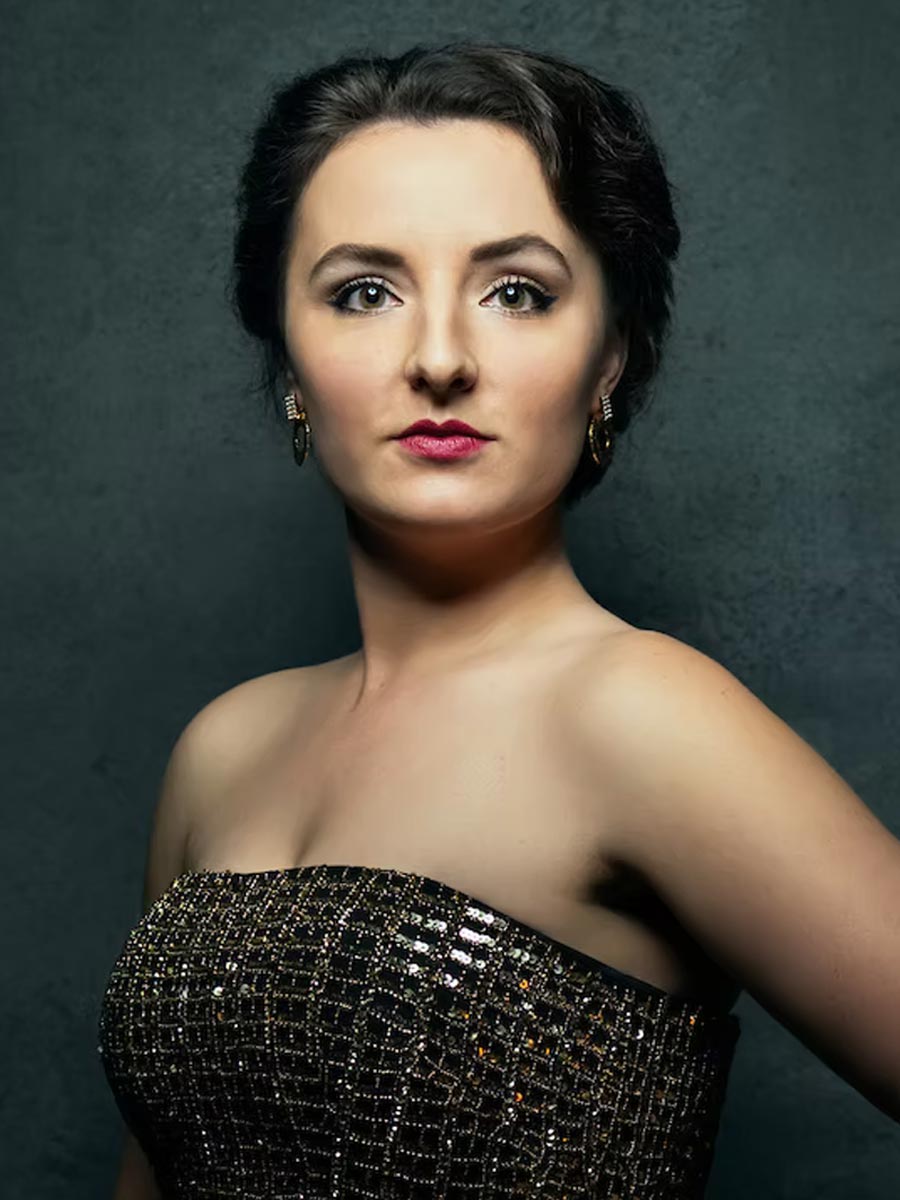
Carolina in Fernanda; Treble Trio in The Diary of One Who Vanished, Written in Secret; Anna in Le Villi; Stephanie in Jake Heggie’s To Hell and Back and Eurydice in Jodi Goble’s Eurydice (world premiere of a new version), Orpheus Retold; Eurydice in Orpheus and Eurydice
Emily Margevich is “a star in the making” (Bachtrack). One of the inaugural Company Artists in OperaDelaware’s groundbreaking employment model, this “poised and fearless prima donna” (Musical America) has been performing on stage since the age of two.
Be it opera, musical theater, or the Great American Songbook, Margevich delivers a performance “as passionate as any Taylor Swift epic” (TheaterMania). This “luminous soprano” (The Wall Street Journal) has “a voice of liquid beauty” (Opera Magazine) that is “big and luxurious, with a cascading quality, like a bolt of silk dropped from a balcony” (Parterre Box).
Emily starred as OperaDelaware’s Tosca in 2025, where her “gorgeous stage presence and voice... of amazing resonance... won the day” (Opera Today). The previous season, she made her OperaDelaware debut as Musetta in La bohème, and she has since sung Nedda in Pagliacci for the company. A graduate of the Academy of Vocal Arts, she sang Tatyana (Eugene Onegin), the Female Chorus (The Rape of Lucretia), Violetta (La traviata), and Musetta there. Her acclaimed Tatyana led to company debuts with Opera Baltimore and Heartbeat Opera, and she has appeared as Donna Elvira in Don Giovanni at the Music Academy of the West.
Behind the scenes, Emily is OperaDelaware’s Education and Community Engagement Manager, visiting schools to share opera in Wilmington, where she lives happily with the love of her life, bass-baritone Dylan Gregg.
This season, Emily makes her role and house debut as Rosalinde (Die Fledermaus) with Knoxville Opera. At OperaDelaware, she sings Carolina in Fernanda, Anna in Le Villi, and Eurydice in Orpheus and Eurydice, and she gives the world premiere of a new version of Jodi Goble’s Eurydice, a through-composed setting of Hilda Doolittle’s Imagist poem that gives voice to the silent Eurydice, created for her in Orpheus Retold.

Anne in Jake Heggie’s To Hell and Back, Orpheus Retold

Don Giovanni in Don Giovanni Portraits; Masetto in Don Giovanni; Vidal in Fernanda; Melchior in Amahl and the Night Visitors; Guglielmo in Le Villi; Pluto in Jonathan Dove’s L’altra Euridice, Orpheus Retold
Baritone Gerard Moon has been praised by OperaWire as “a singer with authority and command and incredible stage presence” and by the Lexington Herald-Leader for his “strong voice, impeccable diction, and a huge sense of fun.” A native of South Korea, Moon is recognized for his rich, lyrical baritone and compelling dramatic presence.
Moon has studied and performed throughout the United States and internationally, with appearances in Italy, Austria, the Czech Republic, New Zealand, Australia, Brazil, and across Asia. He earned a Master of Music in Vocal Performance from the University of Kentucky, where he studied with Cynthia Lawrence, and went on to doctoral studies. His honors include the Alltech Vocal Scholarship, the National Society of Arts and Letters Award Scholarship, the Outstanding Graduate Music Student Award, and the Tom Getchell Scholarship.
A versatile singing actor, Moon has sung many of opera’s most demanding baritone roles, including Figaro (Il barbiere di Siviglia), Germont (La traviata), Ford (Falstaff), Don Giovanni and Leporello (Don Giovanni), the Count (Le nozze di Figaro), the title role in Rigoletto, Dr. Miracle and Coppélius (Les contes d’Hoffmann), Belcore (L’elisir d’amore), and Dr. Falke (Die Fledermaus).
As an OperaDelaware Company Artist, Moon has sung the Mandarin in Turandot (spring 2024), Schaunard in La bohème (fall 2024), Angelotti in Tosca (fall 2025), Gérard in Giordano’s Andrea Chénier (spring 2026), and Tonio in Pagliacci.
This season, he sings Don Giovanni in Don Giovanni Portraits, Masetto in Don Giovanni, Vidal in Fernanda, Melchior in Amahl and the Night Visitors, Guglielmo in Le Villi, and Jonathan Dove’s L’altra Euridice in Orpheus Retold.