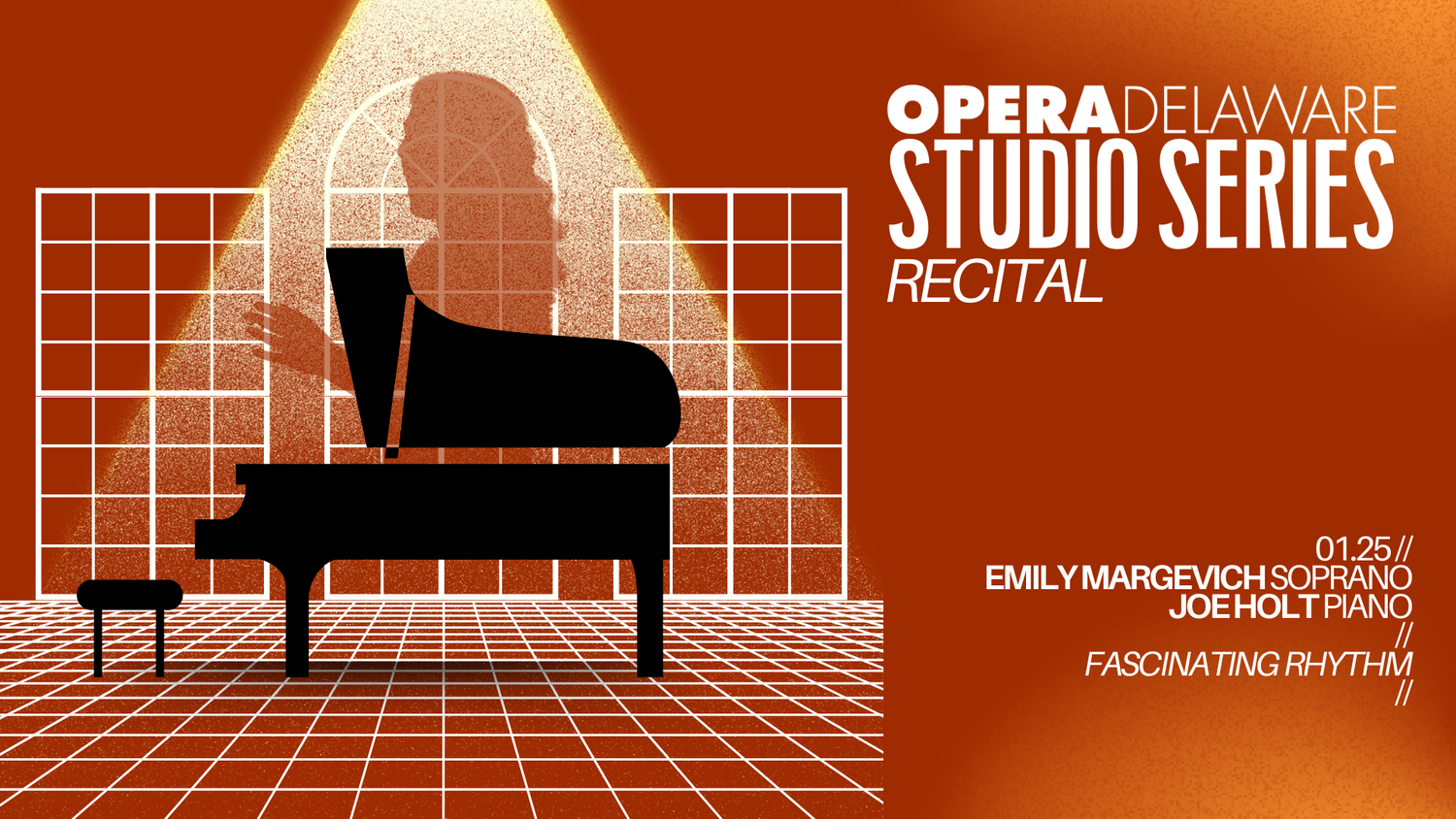
Program notes by Company Artist Emily Margevich for Fascinating Rhythm, her Studio Series recital of the Great American Songbook with pianist Joe Holt on January 25, 2025.
George Gershwin was looking to move on from Tin Pan Alley to a job that would advance his career. He heard that Irving Berlin was looking for a secretary of sorts to transcribe his songs, because Berlin could not read music and could play in only one key. Gershwin went to audition for Berlin by playing a few Berlin songs in a kind of medley with ragtime influences. It is said that Berlin told Gershwin then and there, “Kid, don’t be my secretary. Go out and write your own songs.”
This story inspired my program notes because it speaks to the heart of the Great American Songbook: its collection, its influences, its changes, its creation, its legacy, and its history.
“I’d like to write of the melting pot, of New York City, itself. This would allow for many kinds of music, Black and White, Eastern and Western, and would call for a style that should achieve out of this diversity an artistic unity.” (George Gershwin)
What is so specific and remarkable about the Great American Songbook (GASB) is that it is, all at once, what came before it and what came after it. Our country was experiencing so much, so rapidly, and the songs were turning out just as quickly. There is so much I want to say, because the web of inspiration this era of music casts toward its future is so intense. The GASB tells our country’s story set to music. The advent of radio, transportation, an unregulated economic market, increased leisure, the Industrial Revolution, talking pictures, fame, the workforce, the access to and advertising of celebrities, the Red Summer of 1919, Prohibition, the Great Depression, World War I, and World War II are all inside the loose boundaries of the GASB. Where to begin?!
Some say the GASB is the grouping of the most important songs from 1920 to 1950, or even 1960, including American standards and songs from Broadway musicals and Hollywood movies. I would disagree and argue that the music of George M. Cohan is without a doubt the start of the GASB collection, and that the musical Oklahoma! in 1943 started a new era away from the GASB and into the Golden Age of Musical Theater: enter the book musical. The incomparable collaborations of Rodgers and Hammerstein united two separate creators from the GASB: Oscar Hammerstein, with his groundbreaking musical Show Boat in 1927, for which he also wrote the script, and Richard Rodgers, of Rodgers and Hart, who had four musicals on Broadway in 1927. In 1927 alone, there were 250 shows on Broadway, over 20 million people went to the theater, and eight new Broadway theaters were built. Florenz Ziegfeld produced Show Boat, and that musical changed Broadway and our nation.
No matter what dates one assigns to the imaginary Songbook (or which songs one deems worthy of it), the timeline of American experience within the GASB is staggering. This era brought the most expansion and the most change in entertainment our country had ever experienced, or has since. In an effort to keep this as short as is respectful, I will mention those who must be acknowledged.
Stephen Foster was known as “the father of American music,” with his first published song in the early 1840s. Broadway was inspired by vaudeville, and when vaudeville came to America, our country was booming with innovations. Sounds like great song inspiration to me! Vaudeville shows were America’s most popular form of entertainment at the beginning of the 1900s. If opera came from Florence with Rinuccini and Peri’s Dafne, and vaudeville originated in France, what then is our American music legacy?
By the late 1890s, vaudeville had large circuits in almost every sizable location, with a national following. Our nation’s early opera houses were used for traveling vaudeville shows. Vaudeville was cheap to see, but the variety was enormous. Vaudeville included all of our immigrants in one way or another, on- and offstage or through the sheet music itself; this inclusion ignited Broadway, inspired our songs, and formed the America we know today. The famous test for a vaudeville show was “Will it play in Peoria?” If it would, you had a hit! In 1893, a 26-year-old Florenz Ziegfeld came to Broadway from my hometown, Chicago, looking for acts for the Chicago World’s Fair, and found the European bodybuilder Eugen Sandow. At that time, there were no theaters north of 42nd Street. The center of the modern theater district was created on April 8, 1904, when the city renamed Longacre Square in honor of the newspaper The New York Times.
Times Square became the heart of New York when the subway station opened there six months later, bringing in visitors from all over. The newness, the energy, and the pace of this incredible boom in our history are set to music in the tunes of the GASB. Remember: no radio, no television, and a piano in every home. This period of the GASB represents the amalgamation of everything that was happening in America, in New York City, and to our people at that time.
“Vaudeville was an essential training ground for Broadway musicals.” (Max Wilk, theater historian)
Perhaps the most famous vaudevillian to influence Broadway was the composer, writer, and performer George M. Cohan. He is thought by many to be the first great song-and-dance man of Broadway. He was born into his family’s act, the Four Cohans (watch the movie with James Cagney). Cohan really started my idea of the GASB when he opened Little Johnny Jones on Broadway at the Liberty Theatre in 1904, just one block from the Times Square subway station (which had opened just eleven days earlier). Cohan gave us more than forty shows over three decades. He claimed to have been born on the Fourth of July, and it has been said that his passion was patriotism and his religion was show business. He is the only performer in American history with a statue in Times Square. He is known today for his popular songs, but what he started on Broadway still echoes.
The GASB lived on Tin Pan Alley, a stretch of West 28th Street between Fifth and Sixth Avenues in New York City where music publishers set up shop. Songwriters would go there to try to sell their music, and customers would come in and listen to a pianist play in a tiny studio room to decide whether they wanted to buy the sheet music to take home. So many got their start or found their way there. Early Broadway shows would buy songs from Tin Pan Alley and then build vague plots around these great, popular songs.
It’s been said that Florenz Ziegfeld and his Follies were the equivalent of the melting pot itself. The New Amsterdam Theatre was the showplace of the legendary producer Florenz Ziegfeld (1867-1932), the first great impresario of the American musical. He took the idea of the French Folies Bergère and made it his own. Beauty, spectacle, comedy scenes, music from Tin Pan Alley, gorgeous scenery and costumes, you name it: Ziegfeld sold the best that money could buy. He was a visionary and a legend who started the careers of so many performers, like Fanny Brice, with a song Berlin gave her in 1909 called “Yiddle on Your Fiddle.” He also hired Bert Williams, one of the most prominent vaudeville performers of his time. A famous anecdote about Bert Williams: he asked a bartender for a martini, and the bartender said that’ll be $1,000. Without missing a beat, Williams opened his wallet, smoothly pulled out five thousand-dollar bills, and said, “I’ll have five.” Speaking of money, Ziegfeld went on to lose three million dollars in the Great Depression, but then he, as so many Broadway veterans did, went to Hollywood, where they made Broadway-themed movies.
Irving Berlin came to America from Russia in 1893, when he was five years old. He had a large family, was the son of an Orthodox cantor, and said he never felt poverty because they never knew anything else. He sang at temple and loved to listen to the organ grinders playing opera and ragtime music all around New York City. He wrote the lyrics of his first song, “Marie from Sunny Italy,” while working as a singing waiter in a saloon. The music publisher misspelled his last name, Beilin, as Berlin, and Irving kept it, thinking it was a good name for an American songwriter. As I mentioned, Tin Pan Alley (not Broadway) was the place to go to sell your songs and make connections. With a hit like “Alexander’s Ragtime Band,” Berlin and ragtime were invited into the Broadway scene. Between 1914 and 1962, Berlin wrote almost two dozen Broadway shows for his adopted country and gave us over 1,000 songs in all. In 1942, during World War II, the US government asked Berlin to create a musical, This Is the Army, to boost morale. Its cast was made up of real soldiers, and the proceeds went to the Army Emergency Relief fund. Toward the end of the second act, Irving Berlin came out on stage in his World War I uniform and sang “Oh! How I Hate to Get Up in the Morning.” The show was later adapted for the screen, and a young Ronald Reagan played one of the supporting roles. When Jerome Kern was once asked to place Irving Berlin in the history of American song, he said, “Irving Berlin has no place in American music. Irving Berlin IS American music.”
Rodgers and Hart came into view as a duo when their song “Manhattan” became a hit in 1925. Before that, producers and publishers had rejected their work. I could go on and on about these two fantastic artists. Lorenz Hart was so inspired by Gilbert and Sullivan, and the way he phrases, splits, and dances with the English language is phenomenal. His words are everything the moment calls for, be it funny, delightful, or intimate. I love their musical Babes in Arms, and I did not know they wrote the musical Pal Joey! That show originally starred Gene Kelly on Broadway. See? Everyone started on Broadway.
Ira Gershwin was known as “the jeweler” for his ability to fit words into his brother’s music. George definitely composed from what he could play on the piano, and sometimes it sounded and looked as though he had four hands. The piano rolls of him playing songs seem superhuman! As with all of these composers, I could write for hours about how incredible he was! To have such a distinctive sound at a time when everyone was around and about Tin Pan Alley speaks to the genius of each of the GASB contributors. George White’s Scandals were a big, important fixture of Broadway, and the Gershwins learned their craft writing for these shows. Dances like the Black Bottom came from the Scandals. I would have loved to have been alive during this time!
Cole Porter came from a wealthy family in Indiana. Interestingly enough, he was the composer who gave our country a much-needed balm during the Great Depression. His songs offered an escape, a romantic elegance, and often a feisty playfulness. “Let’s Do It, Let’s Fall in Love,” from the musical Paris, was his first big hit. Porter was an enigma to most, but his contributions of both words and music to so many beautiful creations are clear, classic, beloved, and signature.
Walter Winchell, the American columnist for the New York Daily Mirror known as “the Bard of Broadway,” helped popularize the term “the Big Apple.” Like the jargon of 2025, this Broadway slang infiltrated society. The vernacular of our nation is always in our music. Imagine all the passwords necessary during Prohibition: they made for some of the wittiest, cleverest, most random, secretive, double-entendre-filled, fabulous phrases and songs. We got never-before-heard rhythms and words that melded together just as the classes and cultures mixed, while breaking rules brought creative freedom the likes of which no one had seen or heard before. New York led the nation.
George Boziwick, historian and former chief of the Music Division of the New York Public Library for the Performing Arts at Lincoln Center, uncovered the hidden history of a song all of you know. “Take Me Out to the Ball Game” was Jack Norworth’s ode to his girlfriend, the progressive and outspoken Trixie Friganza. The original verse, which I will sing at my concert, is about a woman enjoying and taking part in what was seen as a man’s space: a baseball stadium. Friganza was a famous vaudeville actress, a feminist, and an unflinching supporter of the fight for the ballot. The musical Suffs (recently on Broadway), along with Gypsy (starring Audra McDonald), speaks to the vaudeville circuit, as does the musical Ragtime. Music has spoken, and will speak, to the moment. The history of Broadway in particular mirrors the culture and history of our young country. The beginning of Broadway is the Great American Songbook, and that’s why I chose this music: to start at my very beginning.
The only trouble I had in creating this program was good trouble, because there are about 100 more songs I wanted to add to this 90-minute recital. Brendan Cooke was so wise to pair me with the inimitable Joe Holt. Because Joe is so uniquely and incredibly talented, I am fortunate to be able to sing any song I want. The feel of a song is the key. He and I had an immediate connection, understanding and knowing this music on a soul and spiritual level. No lengthy explanation is required. We found in each other a true partnership of collaborative space and inspiration. He follows me because I am following him, and we are both following our instinct toward the sacred text and magical music that can never really be explained or learned. My rehearsal process for this recital is not far from the exchange between Berlin and Gershwin over a musical secretary. I needed someone who understood the feel of the music I wanted to program. I learned all of these songs by ear before I even knew I was “learning” them. I learned them from my mom, singing them to me on our front porch; I learned them from my grandma, teaching them to me by rote in voice lessons; and I learned them growing up watching TCM with my family. So I never learned these songs the traditional way I have to learn my opera pieces now.
As artists, we should know where we came from. We should know the composers and the pieces our country and our industry leaned on not too long ago. In fact, our nation stepped away from the European style of opera for a while during the wars. Every event made room for more music. Whether our country inspired the music or our music invited changes in our world, we can use all kinds of music today to help and inspire us in every way. Dorothy Fields, Jerome Kern, Eubie Blake, Ethel Merman, Ethel Waters, Guy Lombardo, Eddie Cantor, Al Jolson, Lillian Lorraine, Fats Waller, DeSylva, Brown, and Henderson, and dozens more, will all be celebrated and talked about during my recital and after the show, when Joe and I give a talkback! Bring all your thoughts and questions to my concert on January 25 or to my inbox at emargevich@operade.org.
Thank you so much for reading and caring!