2016-17 Season
OperaDelaware’s 2016-17 season celebrated the 225th anniversary of Gioachino Rossini’s birth. The 2017 Festival at The Grand Opera House paired his rarely performed tragedy Semiramide with his beloved comedy La Cenerentola (Cinderella). Dramaturg Cori Ellison and Metropolitan Opera radio commentator William Berger gave free pre-performance lectures, and by October 2016, festival ticket sales were running more than 75 percent ahead of the year before. Earlier in the season, the Inside the Opera Studio series brought three intimate concerts, with pianist and commentator Jeffrey Miller, to The OperaDelaware Studios.
Inside the Opera Studio
Three intimate concerts at The OperaDelaware Studios, 4 South Poplar Street, Wilmington, with pianist Jeffrey Miller at the keyboard and providing his always enlightening commentary.
Best of Bel Canto
October 21 and 23, 2016
Soprano Francesca Mondanaro, mezzo-soprano Chrystal E. Williams, tenor William Davenport, and bass-baritone Daniel Mobbs sang Donizetti and Bellini in the style whose name means “beautiful singing,” which prizes beauty of sound above all. Concertgoers could pick up a Casapulla’s sandwich and a glass of wine or beer at the studio before the music began.
Devils, Drunks, and Dastardly Dudes
January 20 and 22, 2017
OperaDelaware favorites Ben Wager, Grant Youngblood, Alok Kumar, and Martin Hargrove took the audience on an operatic tour of men behaving badly.
Ladies’ Night
March 3 and 5, 2017
Not to be outdone by the men, Colleen Daly, Rachele Gilmore, Janara Kellerman, and Felicia Moore returned to Wilmington to close the series with an elegant celebration of the female voice, and a friendly contest to see who could sing the highest, lowest, loudest, and longest.
Sunday Artist Spotlight
OperaDelaware’s Sunday Artist Spotlight recital series returned for a second season with three principal artists from the 2017 Festival operas, La Cenerentola and Semiramide. The recitals took place at The OperaDelaware Studios, each followed by a talk-back session moderated by General Director Brendan Cooke.

Sean Anderson, baritone
December 4, 2016
Baritone Sean Anderson, Dandini in the festival’s La Cenerentola and Ford in the 2016 Festival’s Falstaff, opened the series with a recital of his personal favorites, accompanied by pianist Aurelien Eulert.
Aleksandra Romano, mezzo-soprano
January 8, 2017: canceled
This recital by mezzo-soprano Aleksandra Romano, Arsace in the festival’s Semiramide, was canceled because of illness, and ticket holders received full refunds. Her planned program paired Handel’s “Lascia la spina” with songs from Berlioz’s Les nuits d’été, songs by Rossini, and Elgar’s Sea Pictures.
Megan Marino, mezzo-soprano
February 12, 2017
Mezzo-soprano Megan Marino, Angelina in the festival’s La Cenerentola, appeared courtesy of The Metropolitan Opera. Her program took its title from the opera’s subtitle, La bontà in trionfo (Goodness Triumphant): arias by Rossini, Purcell, and Gluck and Bellini’s Tre ariette, then songs by Britten, Bolcom, Weill, and Jake Heggie. John Arida was at the piano.
Semiramide
Semiramide
Music by Gioachino Rossini
Libretto by Gaetano Rossi, after Voltaire’s Sémiramis
April 29 and May 7, 2017
The Grand Opera House, Wilmington
With the OperaDelaware Orchestra and Chorus
Sung in Italian with English supertitles
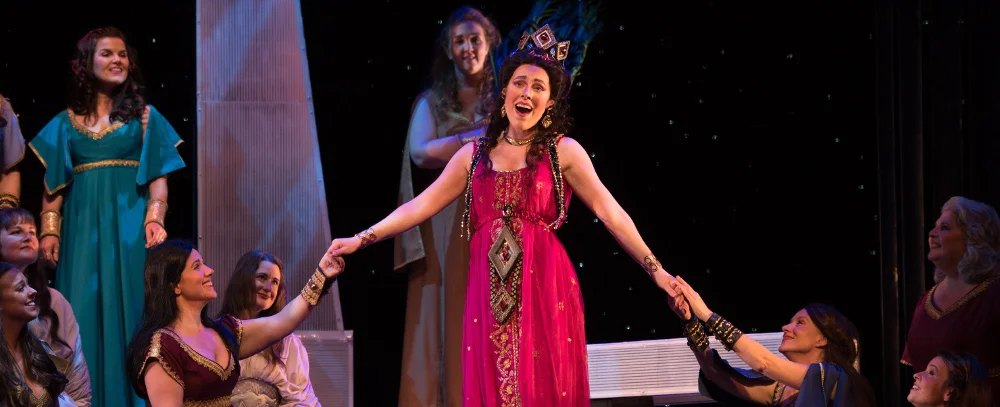
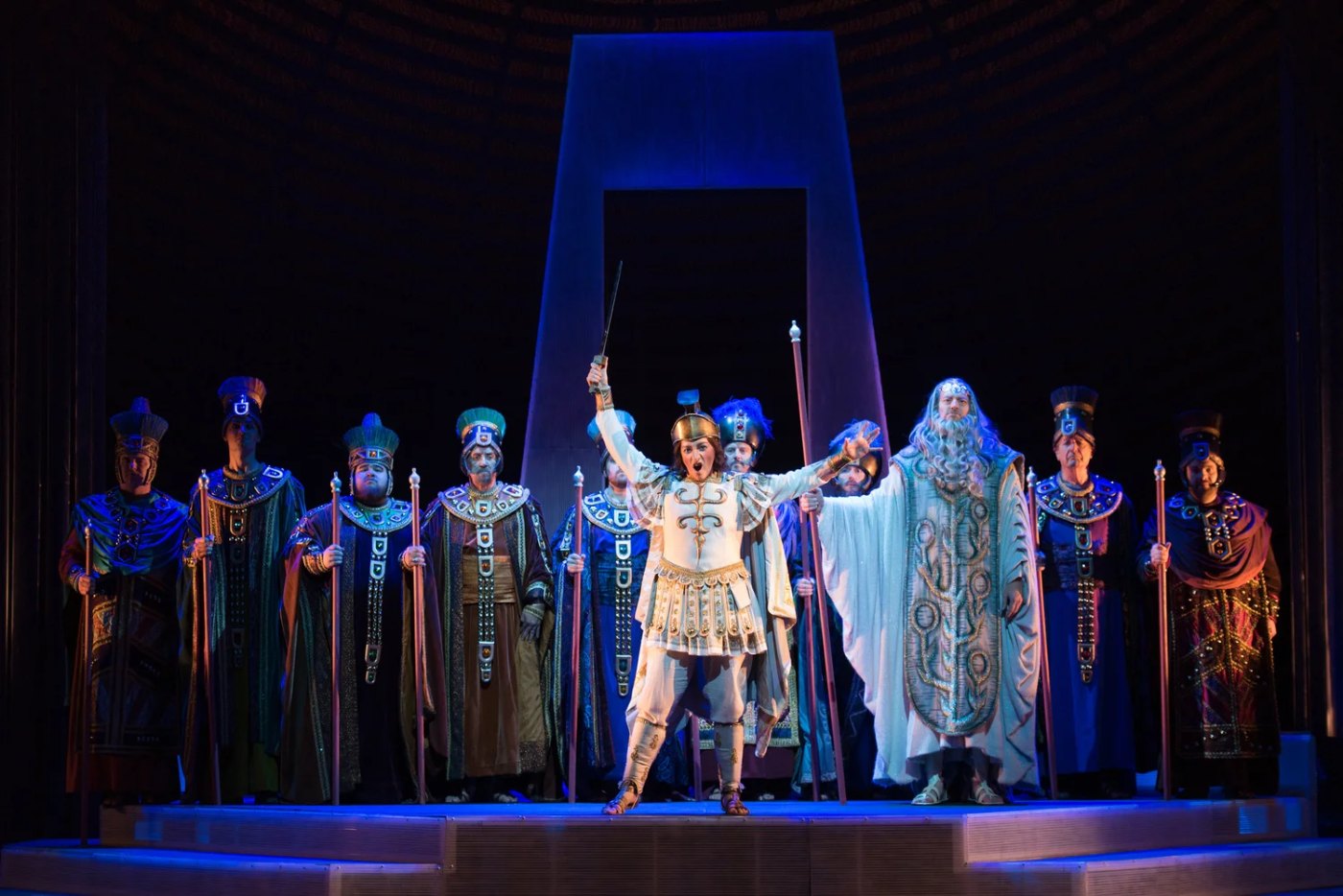
Based on Voltaire’s tragedy Sémiramis, Rossini’s last opera for an Italian stage (1823) tells of a power-hungry Babylonian queen who murdered her husband, and it does not end happily ever after. This rarely performed tour de force is a sumptuous masterpiece, and it suited the intimacy and extraordinary acoustics of The Grand Opera House.
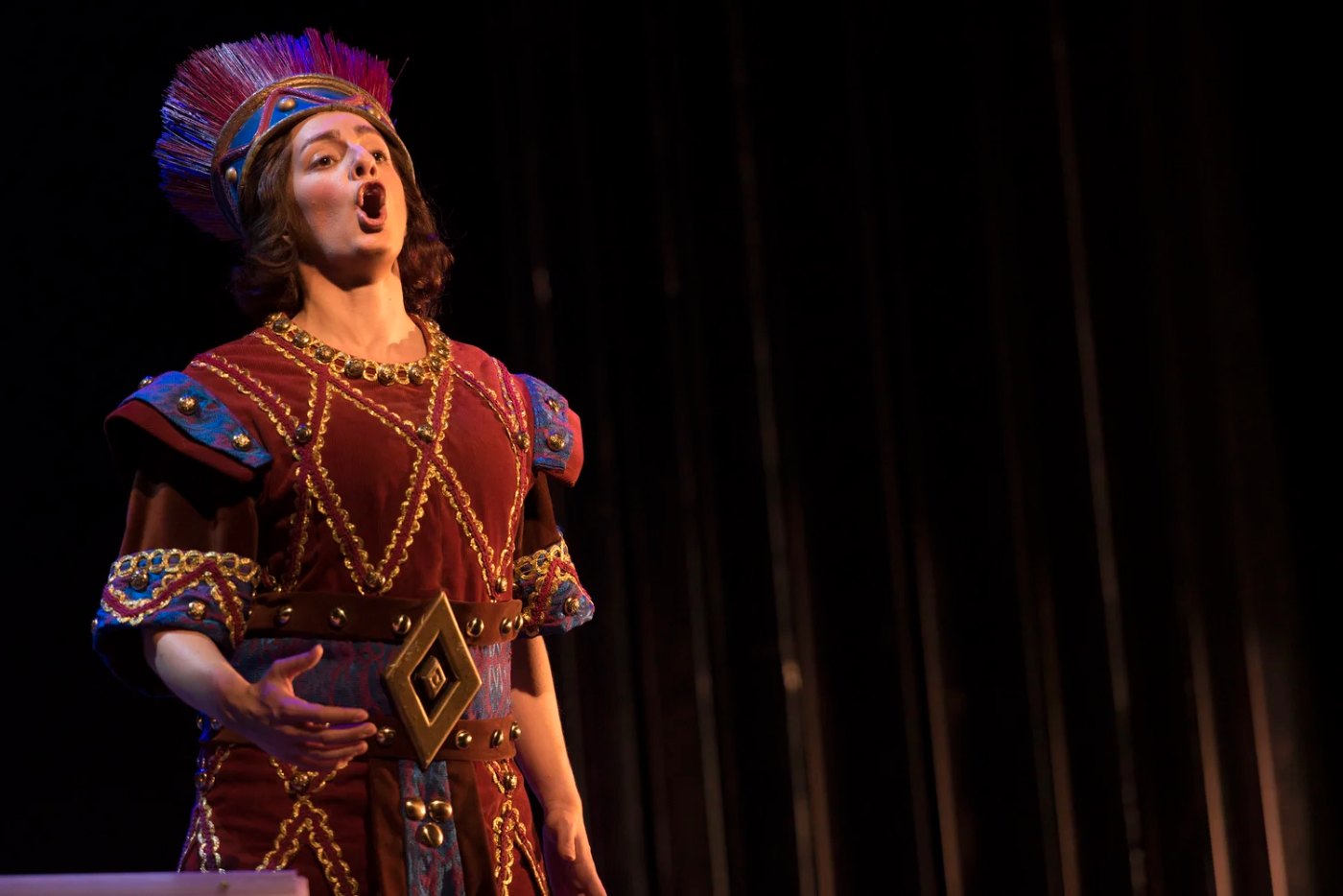
Starring Lindsay Ohse as Semiramide, Aleksandra Romano as Arsace, Timothy Augustin as Idreno, and Daniel Mobbs as Assur. Maestro Anthony Barrese conducted, and Dean Anthony directed.
Romano later said the house’s intimate size let the cast “draw many more colors out of the music” than a 2,000-seat theater would allow.
“A regional company whose plans savvy operagoers far and wide should follow.”
Opera News, on OperaDelaware. Read the review
Aleksandra Romano as Arsace.

Synopsis
Babylon, in legend. Years ago, Queen Semiramide and her lover, Prince Assur, poisoned King Nino, and the young heir, Ninia, vanished. Now the queen must name a new king. Assur expects the throne, but Semiramide has fallen for Arsace, the young commander of her army, who loves the princess Azema, as do Assur and the Indian king Idreno. When Semiramide names Arsace king and her husband, Nino’s ghost rises from his tomb and declares that Arsace will reign once he has avenged a crime. The high priest, Oroe, reveals that Arsace is Ninia, Semiramide’s lost son. In the darkness of Nino’s tomb, Arsace strikes at Assur, but Semiramide steps between them and dies by her son’s hand. Arsace is proclaimed king.
Cast
- Lindsay OhseSemiramide
- Aleksandra RomanoArsace
- Daniel MobbsAssur
- Timothy AugustinIdreno
Creative team
| Conductor | Anthony Barrese |
| Stage Director | Dean Anthony |
La Cenerentola
La Cenerentola (Cinderella)
Music by Gioachino Rossini
Libretto by Jacopo Ferretti
April 30 and May 6, 2017
The Grand Opera House, Wilmington
With the OperaDelaware Orchestra and Chorus
Sung in Italian with English supertitles
Composed 200 years earlier, Rossini’s Cinderella has stood the test of time. Glass slippers are replaced by bracelets, and there is no fairy godmother to be found, but there is still a healthy dose of wicked stepsisters and a happily-ever-after.
Starring Megan Marino as Angelina, Jack Swanson as Ramiro, Sean Anderson as Dandini, and Steven Condy as Don Magnifico. Maestro Michael Borowitz conducted, and A. Scott Parry directed.
Parry staged a Cinderella without magic, as Rossini intended, finding its strength in human characters who comically show their shortcomings and sincerities. The opera’s subtitle, La bontà in trionfo (The Triumph of Goodness), was for him “a persistently important and timely thing to witness.”
“Vibrant, charming and downright funny.”
The News Journal. Read the review
Megan Marino as Angelina and Jack Swanson as Prince Ramiro.
Video: OperaDelaware’s La Cenerentola: 60-second preview (OperaDelaware YouTube channel; opens offsite)


Synopsis
Angelina, called Cenerentola (Cinderella), slaves for her stepfather, Don Magnifico, and his spoiled daughters, Clorinda and Tisbe. Alidoro, tutor to Prince Ramiro, comes to the house disguised as a beggar; the sisters turn him away, but Angelina feeds him. To find a bride who will love him for himself, Ramiro trades places with his valet, Dandini, and he and Angelina fall in love at first sight. With Alidoro’s help, Angelina arrives at the palace ball unrecognized. She gives Ramiro one of a matching pair of bracelets and tells him to find her. When a storm forces the prince’s carriage to stop at Magnifico’s house, he sees the bracelet’s twin on Angelina’s wrist. Now a princess, she forgives her family, and goodness triumphs.
Cast
- Megan MarinoAngelina
- Jack SwansonDon Ramiro
- Sean AndersonDandini
- Steven CondyDon Magnifico
Creative team
| Conductor | Michael Borowitz |
| Stage Director | A. Scott Parry |
Petite messe solennelle
Petite messe solennelle
Music by Gioachino Rossini
May 5, 2017
The Grand Opera House, Wilmington
A special performance of the 2017 Festival
Rossini wrote his Petite messe solennelle (Little solemn mass) in 1863, possibly at the request of Count Alexis Pillet-Will for his wife, Louise, to whom it is dedicated. The composer, who had stopped writing operas more than 30 years before, called it “the last of my péchés de vieillesse” (sins of old age).
The extended work is a missa solemnis, but Rossini labeled it, not without irony, petite (little). He scored it for twelve singers, four of them soloists, with two pianos and harmonium, and it was first performed on March 14, 1864, at the couple’s new home in Paris. Rossini later made an orchestral version that added a setting of the hymn “O salutaris hostia” as a soprano aria. That version was not performed in his lifetime, because he could not obtain permission to perform it with female singers in a church. The company of the Théâtre-Italien first performed it at the Salle Ventadour in Paris on February 24, 1869, three months after his death.
OperaDelaware’s performance featured soprano Colleen Daly, mezzo-soprano Chrystal E. Williams, tenor William Davenport, bass Ben Wager, and the OperaDelaware Chorus, with Maestro David Amado and piano accompaniment. Metropolitan Opera radio host and commentator William Berger gave a free pre-performance talk in the theater.
Artists
- Colleen Dalysoprano
- Chrystal E. Williamsmezzo-soprano
- William Davenporttenor
- Ben Wagerbass
- David Amadoconductor
- OperaDelaware Chorus
Season support
This organization is supported, in part, by a grant from the Delaware Division of the Arts, a state agency, in partnership with the National Endowment for the Arts. Pre-performance lectures were partially funded by a grant from Delaware Humanities, a state program of the National Endowment for the Humanities.